Blog about Rhino Lights

05/21/2020
by Josh Klein

Lumens vs LUX: The Truth About LED Brightness

03/12/2026
by Josh Klein

A lot of lighting companies advertise huge lumen numbers and post overexposed photos to make weak lights look brighter. What actually matters is how much usable light reaches the ground. That is where LUX matters.

What are Lumens?

Lumens measure total light output on paper. It sounds impressive, but it does not tell you how bright the light actually looks when mounted on your vehicle.

What is LUX?

LUX measures how much light actually hits a surface at a tested distance. In simple terms, LUX tells you real usable brightness.

Simple way to think about it

Two lights can claim similar lumen numbers, but one can still look much dimmer in the real world. That is because lumens are a broad output number, while LUX measures the light where it actually matters.

Quick takeaway: Lumens are a spec sheet number. LUX is what your eyes actually experience.
Lumens Total light produced Big total output number LUX Light hitting the ground Measures usable brightness

Why huge lumen claims can be misleading

Many resellers advertise a theoretical lumen number based on what the LED chip could produce under perfect conditions. That does not account for heat, power loss, optics, housing design, or real-world performance.

So while a product page may show a giant lumen claim, the actual light you see on the trail can be much weaker than expected.

What customers really need to know

  • A big lumen number does not guarantee a bright light.
  • Camera tricks can make dim lights look powerful.
  • LUX gives a real tested number for usable brightness.

Photos can be manipulated

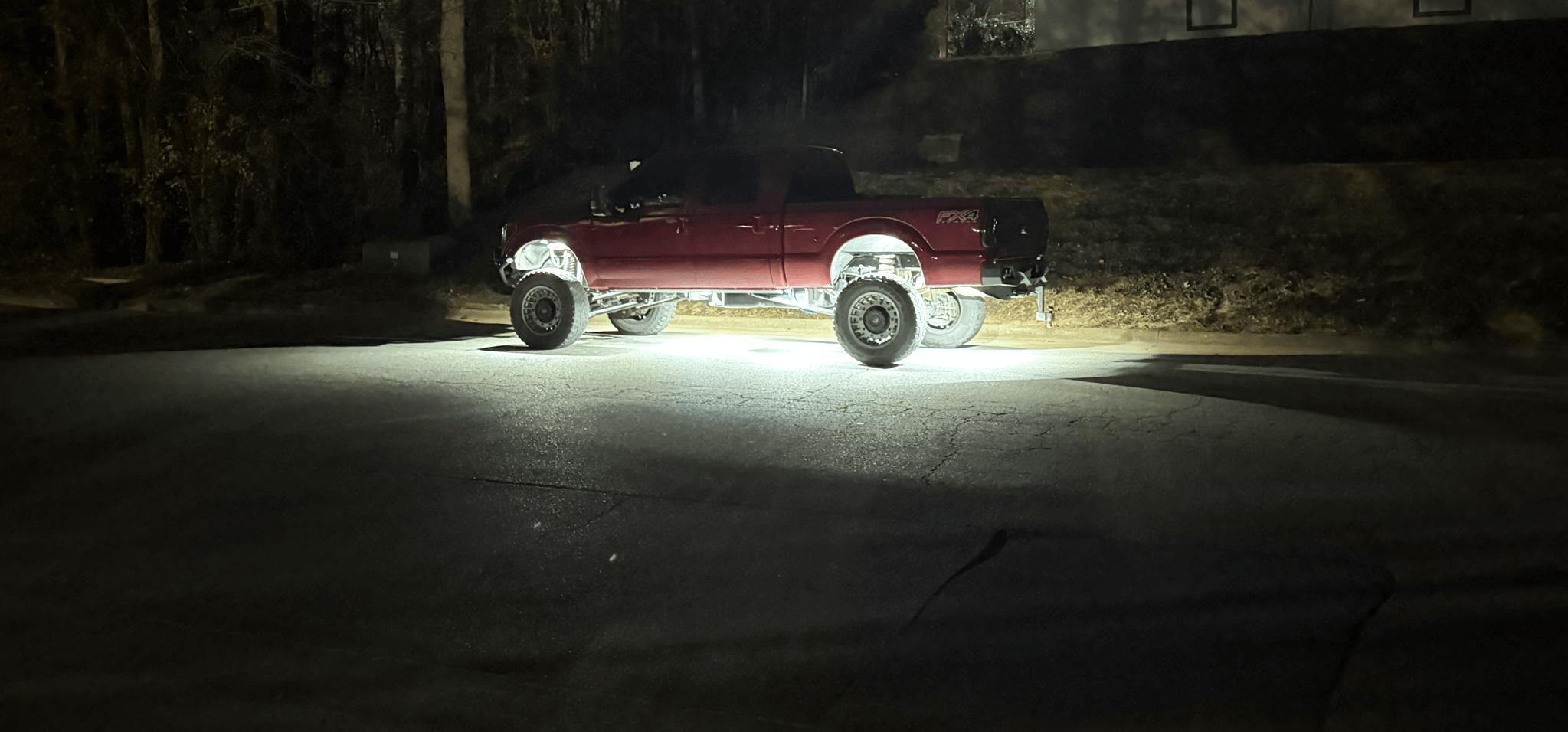
Some companies use dark backgrounds, boosted camera exposure, and edited photos to make lights look much brighter than they really are. A photo can be adjusted. A LUX meter cannot.

The truth: marketing photos are subjective. LUX is measurable.
Overexposed Photo Looks bright because the image is edited LUX Measurement 6300 LUX Gives a real number you can compare

Why Rhino Lights uses LUX

We believe customers should be able to compare lights using a number that reflects real-world brightness, not inflated marketing. That is why LUX testing matters. It helps put actual numbers behind what your eyes will see.

Measurement What it tells you Why it matters
Lumens Total light output Can sound impressive, but does not show real usable brightness
LUX Light intensity on a surface Shows how bright the light actually is where it counts

Measured brightness matters

Below is a simple example of why measured brightness is easier to understand than inflated claims. The stronger the LUX reading, the more usable light reaches the ground.

Example Brightness Comparison More LUX = more usable brightness Generic RGB Light ~550 LUX Diamond Duo ~2200 LUX Axion RGB+W ~6300 LUX

Bottom line

If a company only talks about giant lumen numbers and flashy photos, that does not always mean the light is actually bright.

Lumens are easy to advertise. LUX helps show real performance. That is why measured brightness matters when you are choosing lights for real-world use.
Axion RGB+W Rock Lights: A Dedicated White Channel, Not RGB-Mixed White

11/22/2025
by Josh Klein

Our Axion RGB+W rock lights are engineered, CNC-milled, and hand-built right here in Huntersville, North Carolina.

Most lights on the market rely on inflated wattage claims and imported housings.
Axion is different. Each module uses genuine CREE RGB+W LEDs and produces 20 watts measured at the light — 14.3 V × a measured 1.4 A, read off the supply on our own bench. That is a derived figure, not a separate wattmeter reading.

What makes Axion different

Built in North Carolina

Every Axion housing is CNC-milled from solid billet aluminum, weighing nearly three-quarters of a pound for heat dissipation and long-term reliability. From PCB design to assembly, every step is Rhino-engineered and Rhino-built.

20 watts, measured at the light

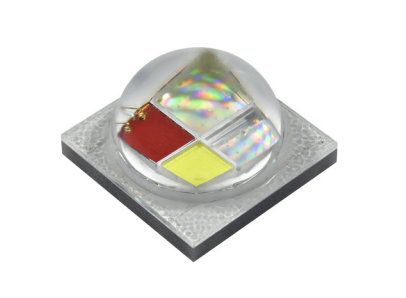
With a dedicated CREE white chip and genuine RGB diodes, Axion produces vibrant, accurate color with no washout. Unlike RGB-mixed white, Axion delivers a clean, pure white that you can actually use for visibility.

Fully linkable digital system

Axion uses a chainable digital signal that allows color patterns and animations to flow smoothly from front to back with zero signal loss — something traditional analog rock lights simply cannot do.

Engineered for real off-road use

Heat-managed, impact-resistant, and weather-sealed, Axion is built to survive real trail abuse. These aren’t parking-lot lights — they’re built for the way you actually use your vehicle.

Four colors. A dedicated white. 8,020 lux at 13 inches, measured on our bench.

Your lighting shouldn’t be limited to a single look. Axion delivers output in all four core colors, and we put the finished light on a meter rather than quoting an LED datasheet: 8,020 lux, read at 13 inches from the assembled light on a handheld meter set to its ×10 range. That is an illuminance reading at that distance — it is not a lumen rating, and at 13 inches from a multi-emitter light it does not convert cleanly to a one-metre figure, so we publish it as what it is.

Red

Strong, deep red with zero pink tones.

Blue

Powerful and crisp, with good nighttime visibility.

Green

Vivid and intense, with none of the washed-out yellow-green common to mixed-color lights.

White

A true CREE white chip output. Clean, clear, and functional.

Each color is shown from multiple angles to highlight beam consistency and intensity.

Time to upgrade your rig

If you’re tired of dim imports, cheap housings, and exaggerated lumen claims, Axion is the answer: a dedicated white channel instead of RGB-mixed white, a billet housing built to shed heat, and a number we measured ourselves rather than copied off a spec sheet.

Axion is part of the RGB+W system. Choose your lighting ecosystem: RGB or RGB+W. Products within that ecosystem can sync together. RGB and RGB+W require separate controllers and do not sync with each other.

Order now at:
https://www.rhinome.com

Engineered by us. Built by us. Serviced by us.
Rhino Lights — designed, built and repaired in Huntersville, North Carolina.

Rock Lights vs. Whip Lights: What You Need and Why

07/14/2025
by Josh Klein

Rock Lights vs. Whip Lights: What You Need and Why

Whether you're new to off-roading or dialing in your setup, one common question is: Should I run rock lights, whip lights, or both? At Rhino Lights, we build both in Huntersville, North Carolina, and we’re here to break down what each one does — and why the right combo takes your ride to the next level.

1. What are rock lights?

Rock lights are mounted under your vehicle to light up the ground and wheel wells. They serve two main purposes:

  • Trail visibility: Light up obstacles, rocks, and terrain under your tires for better night wheeling.
  • Show-stopping looks: RGB or RGB+W options give your rig a head-turning glow with full color control.

Perfect for trail riders, crawlers, and anyone who needs to see what’s happening under the vehicle.

2. What are whip lights?

Whip lights are tall, flexible LED poles mounted to the rear of your UTV, ATV, or truck. Here’s what they’re great for:

  • Safety & visibility: Be seen on dunes, trails, or night rides. Especially critical in low-light, dusty, or hilly terrain.
  • Style & sync: RGB whips run custom colors and animations, and sync with the other RGB products on your rig — Diamond RGB rock lights, RGB strips and RGB halos.

If you ride in groups or open terrain, whip lights are a must-have for safety and style.

3. Why not both?

Rock lights and whip lights serve different purposes — but they’re even better together. When you pair them:

  • You get complete visibility around and behind your vehicle.
  • Your rig stands out with a synchronized, dynamic lighting setup.
  • Choose your lighting ecosystem: RGB or RGB+W. Products within that ecosystem can sync together. RGB and RGB+W require separate controllers and do not sync with each other.

4. Choosing the right kit

Start with the system, not the product. Choose your lighting ecosystem: RGB or RGB+W. Products within that ecosystem can sync together. RGB and RGB+W require separate controllers and do not sync with each other. Once you have picked a side, the kit picks itself:

Running both is physically possible — but it is two systems with two controllers, and they will not sync with each other.

Conclusion: build your setup with purpose

At Rhino Lights, every product is designed, engineered, and built in-house for real off-road abuse. Whether you're lighting under the rig or flying a pair of our 2ft Fattie Whips, the light is built to be serviced, not treated as disposable — file a repair online and track it in your account.

Explore Our Lighting Combos

Why CNC-Milled Housings Matter in Off-Road Lighting

07/10/2025
by Josh Klein

Why CNC-Milled Housings Matter in Off-Road Lighting

When it comes to off-road lighting, most people focus on brightness, colors, or fancy features — but there's one critical detail often overlooked: the housing. At Rhino Lights, we use CNC-milled aluminum housings in our rock lights, whip lights, and pods — and for good reason. Here’s why that matters on the trail.

1. Strength You Can Feel

CNC-milled housings are carved from solid blocks of high-grade aluminum, not cast from molten metal or molded plastic. That makes them:

  • More impact-resistant — perfect for rugged trails, flying gravel, and rock crawls.
  • Less likely to crack or deform — even under extreme pressure or flexing.
  • Built to last — no cheap plastic to dry out or snap over time.

2. Better Heat Management = Longer LED Life

LEDs get hot — and heat kills performance and lifespan over time. Our CNC-milled housings act like a built-in heatsink:

  • Pulls heat away from the LEDs fast
  • Helps maintain brightness and color accuracy
  • Extends overall product life

3. Built in the USA. Controlled by Us.

Because we design, machine, and assemble everything in-house, we have total control over the final product:

  • Tighter tolerances and better fits
  • Cleaner wiring layouts
  • Stronger, more secure seals against water and dirt
  • No outsourcing, no guessing, no cut corners

4. Looks That Match the Performance

Let’s be honest — billet CNC just looks badass. Our housings don’t just perform under pressure; they add a clean, industrial look — and the housing is doing the thermal work, not just holding the LED.

When your rig is built with purpose, every part should reflect that — including your lighting.

Conclusion: Rhino Strong from the Inside Out

At Rhino Lights, we don’t just slap our name on off-the-shelf components. We engineer, CNC-machine, and hand-build each housing right here in North Carolina because we know what real off-road abuse looks like.

So next time you’re comparing lights, don’t just count LEDs — check the housing.

Shop CNC-Milled Lighting

Why Rhino Whip Lights Are Built to Outlast and Outperform

06/22/2025
by Josh Klein

When it comes to LED whip lights, not all products are created equal. At Rhino Lights LLC, we take pride in engineering and building every product in-house — right here in Huntersville, North Carolina. Our Rhino 2.0 Whip Lights aren’t just lights — they’re a statement of quality, durability, and performance that puts cheap imports to shame.

Built in North Carolina, built to be serviced

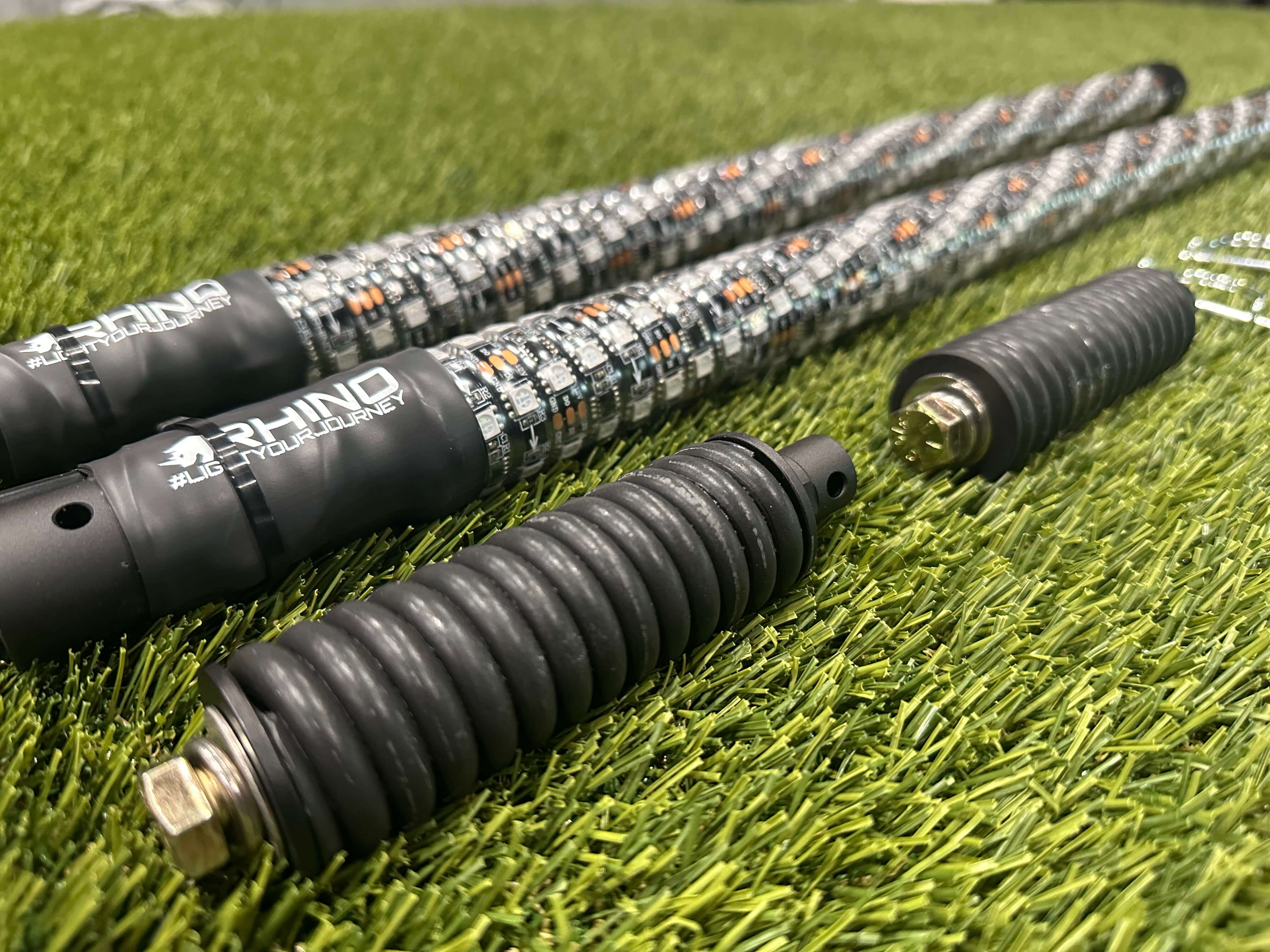
Unlike most whip lights on the market, which are mass-produced overseas with cost-cutting materials, our Rhino 2.0 Whips are hand-built using 1-inch thick fiberglass rods manufactured in the USA. This thickness gives our whips a solid, upright stance that prevents slouching, protects the LED strip from stress, and adds real durability on rough terrain.


Dense, continuous strip we build to length

We don’t space out our LED strips to cut corners. Instead, we wrap each whip 360° with tightly packed, hand-selected 5050 RGB LEDs — giving you a dense, continuous band of color with no dark gaps between the LEDs. For example, our 4-foot whip packs in over 462 LEDs for an even wash of color the whole length of the whip.

Designed for real-world abuse

Every Rhino whip includes:

  • CNC-milled 6061-T6 aluminum end caps

  • UV-protected ultra-clear PVC heat shrink

  • Custom-built quick-disconnect springs, wound in North Carolina, designed to absorb impact and minimize flex

  • 18 AWG pigtails for higher current draw and better performance

We don't just build whips — we build systems that work together. Our in-house syncing platform pairs your whips with the other lights on the same system — RGB with RGB, RGB+W with RGB+W. Halos are RGB.

Repairable. Serviceable. Not disposable.

Most imported whips are disposable — when they break, you toss them. Not ours. Our whips are fully serviceable, and because we build every component ourselves, the people who made them can also repair them — through an easy online RMA process, tracked in your account. A broken whip is a repair, not a re-order.

Add turn, brake and reverse with Connex

Want to take it further? Our Connex Pro addon board, built in North Carolina, brings your whip lights to life with turn signals, brake lights, reverse modes, and even Patriot and SOS patterns — functionality you won’t find in typical imported products. Connex Pro and Connex Lite run on the Rhino RGB system only, which is where the 2.0 whips live. They do not control Axion rock lights or Rhino 3.0 RGB+W whips.

Why Rhino?

  • Engineered and built in North Carolina

  • Hand-built & serviceable

  • Dense, continuous strip we build to length

  • Heavy-duty, upright spring design

  • Custom syncing system

  • Backed by real support, not a reseller

Ready to upgrade?

If you're serious about quality, performance, and supporting lights engineered and built in North Carolina — it’s time to ride with Rhino Lights.

RGB vs. RGB+W LEDs: What's the Difference and Why It Matters

05/03/2025
by Josh Klein

RGB vs. RGB+W LEDs: what's the difference, and why it matters

When choosing off-road lighting like whip lights or rock lights, you may come across two common terms: RGB and RGB+W. While they might sound similar, they offer different capabilities when it comes to color and performance. At Rhino Lights, we offer both options, and we’re here to break down the key differences so you can choose the right setup for your build.

Two systems — pick one

Choose your lighting ecosystem: RGB or RGB+W. Products within that ecosystem can sync together. RGB and RGB+W require separate controllers and do not sync with each other.

The RGB system

The RGB+W system

Can I run both? Physically yes — as two separate systems with two controllers. They will not sync with each other.

One scope note while you are choosing: Connex Pro and Connex Lite run on the Rhino RGB system only. They do not control Axion rock lights or Rhino 3.0 RGB+W whips.

What is RGB?

RGB stands for Red, Green, and Blue. These three colors combine to create a wide spectrum of colors through mixing. RGB LEDs are great for vibrant color effects, cycling patterns, and visual customization. However, when it comes to producing true white, RGB has a limitation. To make white, RGB LEDs mix red, green, and blue at full intensity—this creates a white that often appears slightly bluish or purple.

What is RGB+W?

RGB+W takes RGB a step further by adding a dedicated white LED chip into the mix. This fourth chip produces a pure, true white that’s cleaner than what RGB alone can deliver. RGB+W LEDs allow you to enjoy both stunning colors and crisp white light when needed—ideal for utility, clarity, or a clean look.

Key differences at a glance

Feature RGB RGB+W
White light Simulated by mixing red, green and blue True white from a separate white chip
Color range Full RGB mixing across the spectrum The same RGB mixing, plus a dedicated white channel
Brightness Strong color output Cleaner white output and better contrast
Use case Color, patterns and animation — Diamond RGB's 24 addressable LEDs per light Color plus a working white you can actually see by

Why it matters for off-road lighting

When you're hitting the trail, clarity and durability matter. RGB lighting is perfect for eye-catching displays, accent lighting, or show builds. If you want a true working white alongside color, choose RGB+W. If you are building around patterns, animation and the broadest accessory range, RGB is the mature platform.

At Rhino Lights, our RGB and RGB+W whip lights and rock lights are engineered in-house with quality and performance in mind. Whether you choose RGB or RGB+W, you’re getting high-grade components built to handle the roughest conditions.

Bottom line

Pick the ecosystem first, then pick the products inside it. RGB is the mature platform with the broadest accessory range; RGB+W adds a dedicated white channel for when you need light you can work by. Either way, we engineer and build both systems in Huntersville, North Carolina, and we build them to be serviced, not treated as disposable.

The LED Wattage Myth: Why More Watts Doesn’t Mean More Brightness

02/14/2025
by Josh Klein

When it comes to LED lighting, many companies, especially overseas manufacturers, push the idea that higher wattage means a brighter light. You’ve probably seen those ads: '1000-watt LED light bar!' or '500-watt rock lights!' But here’s the truth: more watts do not equal more brightness. Let’s break down why.

Wattage vs. Brightness: What’s the Difference?

Wattage measures power consumption, not brightness. Brightness is actually measured in lumens. High-quality LEDs are designed to produce more lumens with less power. Simply put: a 50-watt high-efficiency LED can be brighter than a 100-watt cheap LED.

The Heat Problem: Why Cheap LEDs Can’t Run at Full Power

It is common practice to fit a large number of low-cost emitters and print the sum of their component ratings on the box. That number describes what the parts could do in a lab, not what the assembled light delivers. However, here’s the catch: they can’t run those LEDs at full power without causing severe overheating.

Why? Because cheap housings and poor thermal management mean the heat has nowhere to go. Running LEDs at maximum power without proper cooling would cause the housing to melt, burn out the chips, and drastically shorten the light’s lifespan. So, they lower the power output to avoid overheating, meaning that massive wattage number is pure marketing, not reality.

Quality Over Quantity: What Matters Most in an LED

Here’s what actually makes an LED better and brighter:

  • High-Quality LED Chips: Efficient, powerful chips produce more lumens with less power.
  • Proper Thermal Management: Quality CNC-milled housings, heat sinks, and proper engineering allow LEDs to run cooler and longer.
  • True Power Output: Honest wattage ratings from reputable brands reflect real performance.

How Rhino Lights Does It Differently

At Rhino Lights, we design and build our lights in-house, focusing on engineering, efficiency, and performance. Our LEDs use true Cree chips, known for their high lumen output and efficiency. Plus, with our CNC-milled housings and advanced thermal management, our lights can run at their full potential without overheating.

We don’t play the numbers game—we play the performance game. That’s why our lights outshine and outlast the competition.

Bottom Line

Don’t be fooled by flashy wattage numbers. When it comes to LEDs, quality, engineering, and efficiency are what matter most. Choose lights built to perform, not just to market.

#RhinoLights #QualityRedefined #LeadDontFollow

Revolutionizing Off-Road Lighting: Introducing Our New RGB+W Rock Lights

09/15/2024
by Josh Klein

At Rhino Lights LLC, we're committed to pushing the boundaries of off-road lighting technology to enhance your adventure experiences. We’re thrilled to announce the development of our latest innovation: rock lights built around genuine CREE RGB+W LED diodes.


Why RGB+W?

RGB+W stands for Red, Green, Blue, and White LEDs, an advancement from the traditional RGB (Red, Green, Blue) lighting systems. The addition of the white diode to our setup makes a significant difference. Here’s why:

  1. Enhanced brightness: Our new rock lights are powered by Cree RGB+W LED chips, chosen for their output and efficiency. The white LED enhances the overall luminosity, providing you with a much brighter and clearer illumination compared to standard RGB systems.
  2. True-to-life colors: The inclusion of the white diode allows for more accurate color rendering and a wider spectrum of color combinations. This means that your off-road vehicle will not only shine brighter but also display more vivid and true-to-life colors.
  3. Improved visibility: Whether you’re navigating through rocky trails or setting up camp at night, the increased brightness and clarity from the RGB+W setup improve visibility and safety. You’ll be able to see obstacles and hazards more clearly, ensuring a safer off-road experience.

Why choose our rock lights?

  1. Engineered and built in North Carolina: We design, assemble and test these rock lights in Huntersville, North Carolina. Building them in our own shop is what makes rigorous quality control possible — and it is why the people who built your lights can also repair them.
  2. Durability and performance: Designed to withstand harsh off-road conditions, our RGB+W rock lights are built with rugged materials and engineering to handle vibrations, weather, and extreme temperatures.
  3. Versatile applications: Whether you’re lighting up your vehicle for show purposes or enhancing your trail visibility, our rock lights are versatile enough to meet a variety of needs.
  4. Easy installation: We’ve designed our rock lights for straightforward installation, so you can quickly equip your vehicle with our advanced lighting technology and hit the trails with confidence.

Join us on the bright side

The launch of our RGB+W rock lights is just the beginning of our commitment to innovation in off-road lighting. We believe that enhancing your adventure experience starts with lighting that holds up, and our new rock lights are designed to deliver just that.

Stay tuned for more updates and product releases from Rhino Lights LLC. If you have any questions or need more information about our new RGB+W rock lights, feel free to reach out. We’re here to help you light up your off-road journey!

Analog vs. Digital RGB+W Rock Lights: The Next Level of Off-Road Lighting

09/15/2024
by Josh Klein

At Rhino Lights LLC, we’re always striving to innovate and enhance your off-road experience. Our latest development in rock lighting technology is a perfect example of this commitment: transitioning from analog to digital RGB+W signals. This advancement brings a host of benefits, including new functionalities and greater flexibility. Let’s dive into the differences and advantages of digital RGB+W rock lights over their analog counterparts.

First, the decision that shapes everything downstream. Choose your lighting ecosystem: RGB or RGB+W. Products within that ecosystem can sync together. RGB and RGB+W require separate controllers and do not sync with each other. The digital rock lights described below sit on the RGB+W side of that choice.

Analog vs. digital signals

Analog rock lights: Analog RGB+W rock lights use a continuous signal to control the color and brightness of the LEDs. While this method is straightforward, it has some limitations:

  • Limited functionality: Analog systems typically offer basic color changes and brightness adjustments but lack advanced features.
  • Signal interference: The continuous signal can be susceptible to interference and may not provide consistent performance under various conditions.
  • Less flexibility: Once set, analog systems have limited capacity for additional functionalities or updates.

Digital RGB+W rock lights: Digital RGB+W rock lights utilize a digital signal to control the LEDs. This method offers several significant advantages:

  • Enhanced control: Digital signals allow for precise control of color and brightness, providing a richer and more dynamic lighting experience.
  • Advanced features: A digital signal carries more than color. It leaves room for functions layered on top of the light — turn signal, brake and reverse behaviour, driven from the RGB+W controller rather than from a second set of wires.
  • Signal interruption: The digital signal can be interrupted and adjusted in real-time, enabling more complex lighting effects and functionalities without compromising the overall performance.
  • Consistency and reliability: Digital systems offer improved reliability and performance consistency, minimizing interference and delivering a stable lighting experience.

Where turn, brake and reverse come from

One of the standout features of a digital RGB+W system is that the safety functions ride on the same data line as the color. On the RGB+W system those functions are driven by the RGB+W controller itself, which enhances both safety and aesthetics:

  1. Turn signal integration: Easily synchronize your rock lights with your vehicle’s turn signals for seamless illumination when turning.
  2. Braking functionality: Enhance visibility during braking with dedicated lighting that activates in conjunction with your vehicle’s brake lights.
  3. Reverse lights: Illuminate your path when reversing, providing additional safety and clarity.

Because the controller handles multiple functions simultaneously, your rock lights can adapt to various driving conditions and requirements with ease.

A scope note on Connex. Connex Pro and Connex Lite run on the Rhino RGB system only. They do not control Axion rock lights or Rhino 3.0 RGB+W whips. If you are building on the RGB+W system, turn, brake and reverse come from the RGB+W controller — not from a Connex board.

Why upgrade to digital RGB+W rock lights?

  1. Technology that keeps up: Digital RGB+W rock lights represent the direction off-road lighting is heading. Their advanced features and flexibility keep your lighting setup current and versatile.
  2. Enhanced safety: With integrated functionalities like turn signals and braking lights, your off-road vehicle will be more visible and safer in various driving conditions.
  3. Greater customization: Digital control allows for a wider range of color and brightness options, letting you customize your lighting to suit your style and needs.

Experience the difference

Upgrade your off-road lighting experience with our digital RGB+W rock lights and take advantage of the advanced features and benefits they offer. At Rhino Lights LLC, we’re dedicated to providing solutions that elevate your adventure — engineered and built in Huntersville, North Carolina, and built to be serviced, not treated as disposable.

For more information about our digital RGB+W rock lights, or about how the RGB+W controller drives turn, brake and reverse, feel free to reach out to us. We’re glad to help you work out which system your build should be on.

Contact Us

Why Quality Matters: The Differences Between Rhino Lights and Cheap Imported Off-Road Lighting

09/15/2024
by Josh Klein

When it comes to off-road lighting, investing in high-quality products can make a significant difference in performance, safety, and durability. At Rhino Lights LLC, we are committed to providing superior lighting solutions that stand the test of time. Unfortunately, not all off-road lights are created equal. Here’s why choosing high-quality lighting, like our products, over cheap imported alternatives is crucial for your off-road adventures.

The Pitfalls of Cheap Imported Off-Road Lighting

  1. Lack of Quality Control: Cheap imported rock lights often prioritize cost savings over quality. This approach can lead to several issues:
    • Inconsistent Performance: Without rigorous quality control, the performance of these lights can vary widely, leading to unreliable illumination.
    • Shortened Lifespan: Poorly manufactured components can lead to premature failures, leaving you with lights that don’t last.
  2. Improper Power and Amp Draw Calculations: Many inexpensive lights do not correctly calculate power and amp draw. This oversight can have serious consequences:
    • Overdriven LEDs: When LEDs are overdriven, they can overheat and fail prematurely. Cheap lights often lack the necessary calculations to prevent this, leading to a reduced lifespan.
    • Increased Risk of Failure: Inaccurate power calculations can also lead to inconsistent brightness and potential electrical failures.
  3. Lack of Thermal Management: Proper thermal management is essential for the longevity of LED lights:
    • Overheating Issues: Without adequate cooling, LEDs can overheat, significantly shortening their lifespan. Cheap lights often lack effective thermal management solutions.

Why Rhino Lights Stands Out

At Rhino Lights LLC, we take pride in our commitment to quality and precision. Here’s how our products are designed to outperform the competition:

  1. Advanced Thermal Management with CPU Chips:
    • PWM Control: We use advanced CPU chips to pulse-width modulate (PWM) the LED chips. This technique ensures that the LEDs operate within safe temperature ranges, preventing overheating and extending the lifespan of the lights.
    • Effective Cooling: Our lights are engineered with effective cooling solutions to manage heat dissipation, ensuring optimal performance even under the toughest conditions.
  2. Precise Power and Amp Draw Calculations:
    • Data Sheet Calculations: We carefully calculate power and amp draw based on detailed data sheets provided by LED manufacturers. This precision ensures that our lights are driven safely and efficiently.
    • Optimized Performance: By adhering to these calculations, we prevent overdriving the LEDs, ensuring consistent brightness and reliability.
  3. Durability and Reliability:
    • High-Quality Components: We use only high-quality materials and components in our lights, which contributes to their durability and longevity.
    • Rigorous Testing: Our lights undergo rigorous testing to ensure they meet our high standards and perform reliably in real-world conditions.

The Rhino Lights Advantage

Investing in Rhino Lights means choosing a product designed with attention to detail and a commitment to quality. Our advanced thermal management and precise power calculations ensure that your off-road lighting performs optimally and lasts longer, providing you with the reliability you need on your adventures.

Don’t compromise on quality when it comes to your off-road lighting. Choose Rhino Lights LLC for superior performance, durability, and peace of mind. For more information about our products and how they stand out from the competition, feel free to reach out to us. We’re here to help you light up your off-road journeys with the best in lighting technology!